Introduction
Most computer programs that solve real-world problems are much larger than simple programs. They are larger programs.
Experience has shown that the best way to develop and maintain a large program is to construct it from smaller pieces, each of which is more manageable than original program.
- This technique is called divide and conquer.
In C, functions are used to modularize programs.
The C standard library provides a rich collection of functions for performing common mathematical calculations, string manipulations, character manipulations, input/output, and many other useful operations. This makes your job easier, because these functions provide many of the capabilities you need.
Familiarize yourself with the rich collection of functions in the C standard library.
Avoid reinventing the wheel. When possible, use C standard library functions instead of writing new functions. This can reduce program development time. These functions are written by experts, well-tested and efficient.
You can write functions to define specific tasks that may be used at many points in a
program. These are sometimes referred to as programmer-defined functions.
Functions are invoked by a function call, which specifies the function name and provides information (as arguments) that the function needs to perform its designated task.
Functions
Functions allow you to modularize a program.
- All variables defined in function definitions are local variables—they can be accessed only in the function in which they’re defined.
- Most functions have a list of parameters that provide the means for communicating information between functions via arguments in function calls.
- A function’s parameters are also local variables of that function.
There are several motivations for “functionalizing” a program.
- The divide-and-conquer approach makes program development more manageable.
- Another motivation is software reusability—using existing functions as building blocks to create new programs.
- A third motivation is to avoid repeating code in a program. Packaging code as a function allows it to be executed from other locations in a program simply by calling the function.
Each function should be limited to performing a single, well-defined task, and the function name should express that task. This facilitates abstraction and promotes software reusability.
If you cannot choose a concise name that expresses what the function does, it’s possible that your function is attempting to perform too many diverse tasks. It’s usually best to break such a function into smaller functions—this is sometimes called decomposition.
Functions Syntax – Definition
Each program that we have written so far has consisted of a function called main that called standard library functions to accomplish its tasks. We now consider how to write custom functions.
The syntax for a C function declaration is as follows:
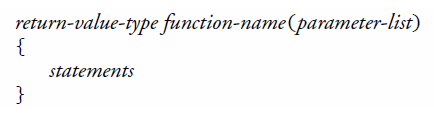
The return-value-type void indicates that a function does not return a value.
Together, the return-value-type, function-name and parameter-list are sometimes
referred to as the function header.
- Include parameter names in function prototypes for documentation purposes. The compiler ignores these names, so the prototype int maximum(int, int, int); is valid.
Choosing meaningful function names and meaningful parameter names makes programs more readable and helps avoid excessive use of comments.
return_type function_name(parameter1_type parameter1, parameter2_type parameter2, ...);Where:
return_typeis the data type of the value returned by the function, such asint,float,double,void, etc.function_nameis the name of the function, which should follow C naming conventions and be descriptive of what the function does.parameter1_type,parameter2_type, etc., are the data types of the parameters passed into the function.parameter1,parameter2, etc., are the names of the parameters passed into the function.
For example, a simple function that takes two integer parameters and returns their sum could be declared as follows:
int sum(int a, int b);- Include parameter names in function prototypes for documentation purposes. The compiler ignores these names, so the prototype int maximum(int, int, int); is valid.
And the implementation of the function would look something like this:
int sum(int a, int b) {
    return a + b;
}
When calling a function, you pass in arguments that match the parameter types declared in the function declaration. For example :
int result = sum(3, 5);This would call the sum() function with a set to 3 and b set to 5, and assign the result 8 to the result variable.
NOTE :
The compiler compares the function calls to the function prototype to ensure that:
- the number of arguments is correct,
- the arguments are of the correct type,
- the argument types are in the correct order, and
- the return type is consistent with the context in which the function is called.
Example :
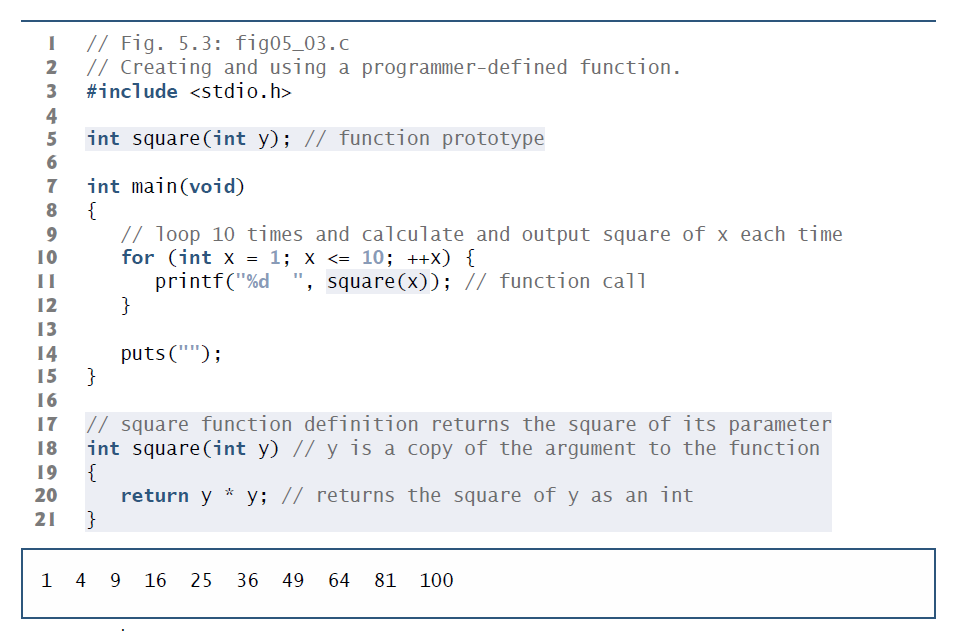
NOTE :
- Redefining a parameter as a local variable in a function is a compilation error.
- Although it’s not incorrect to do so, do not use the same names for a function’s arguments and the corresponding parameters in the function definition. This helps avoid ambiguity.
The statements within braces form the function body, which is also a block. Variables can be declared in any block, and blocks can be nested (but functions connot be nested).
Returning control from functions
There are three ways to return control from a called function to the point at which a function was invoked.
If the function does not return a result, control is returned simply when the function-ending right brace is reached, or by executing the statement
return;
If the function does return a result, the statement
return expression;
returns the value of expression to the caller.
The return value of main is used to indicate whether the program executed correctly.
return 0;
at the end of main — 0 indicates that a program ran successfully.

