About C
C is one of the earliest high level programming language. It came in 1972.
C is a general-purpose programming language that is widely used in the development of operating systems, system software, and other complex applications.
It was originally developed by Dennis Ritchie at Bell Labs in the early 1970s to write the UNIX operating system, and has since become one of the most popular programming languages in the world.
One of the main reasons for the popularity of C is its efficiency and speed. C code can be compiled to machine code, which means that it can be executed directly by a computer’s processor, without the need for interpretation by an intermediate program. This makes it ideal for developing software that requires high performance, such as operating systems, embedded systems, and games.
C is also a relatively simple language, with a small set of keywords and a straightforward syntax. This makes it easy to learn, even for beginners, and provides a good foundation for learning other programming languages.
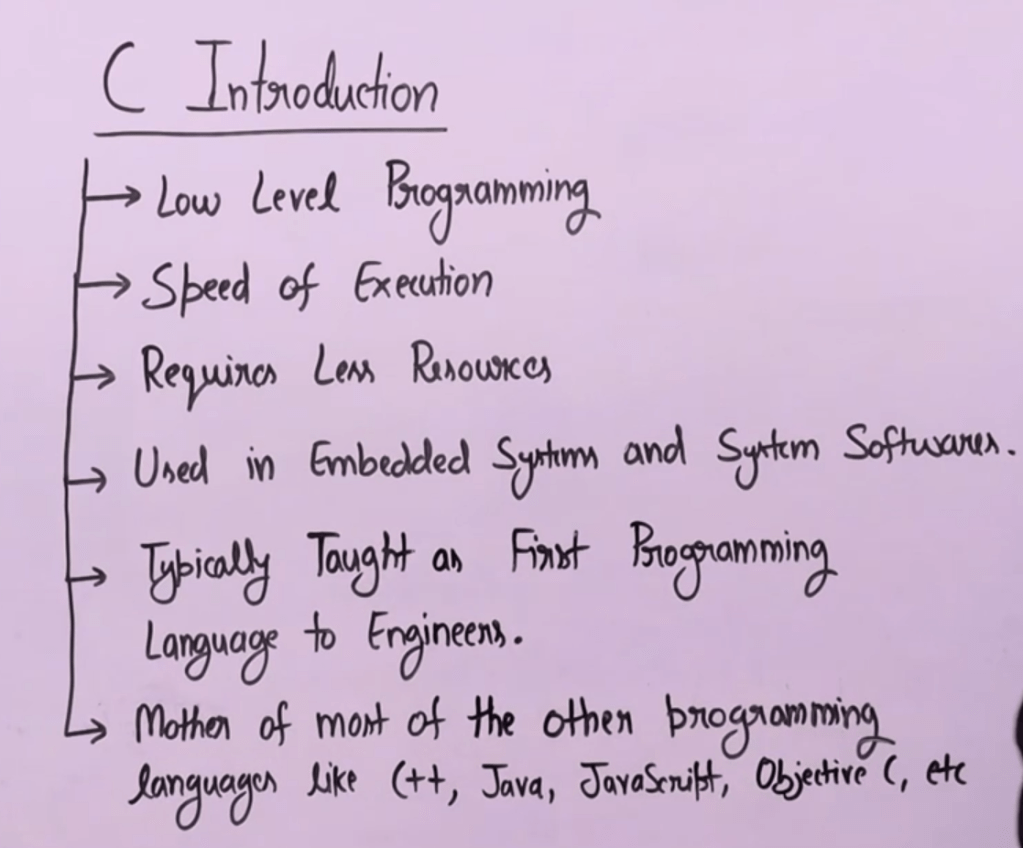
Here are some of the key features of the C programming language:
- Simple syntax: C has a relatively simple syntax, with a small set of keywords and a straightforward grammar. This makes it easy to read and write C code, even for beginners.
- Low-level programming: C allows programmers to write low-level code that can access hardware resources directly. This makes it ideal for developing operating systems, device drivers, and other system-level software.
- Pointers: C has a powerful feature called pointers, which allow programmers to manipulate memory directly. This makes it possible to write efficient code that can allocate and deallocate memory dynamically, and to pass data between functions without copying it.
- Standard libraries: C comes with a large set of standard libraries that provide useful functions for working with strings, arrays, files, and other data structures. These libraries are available on all platforms that support C, making it easy to write portable code.
- Portability: C code can be compiled to run on a wide variety of platforms, including Windows, macOS, Linux, and many others. This makes it a popular choice for developing cross-platform software.
Overall, C is a powerful and versatile programming language that is well-suited to a wide range of applications. Whether you are a beginner or an experienced programmer, learning C can provide a solid foundation for building your skills and developing complex software.
Example Applications
C is a powerful programming language that has been used to develop a wide range of applications. Here are some examples of applications that have been written in C:
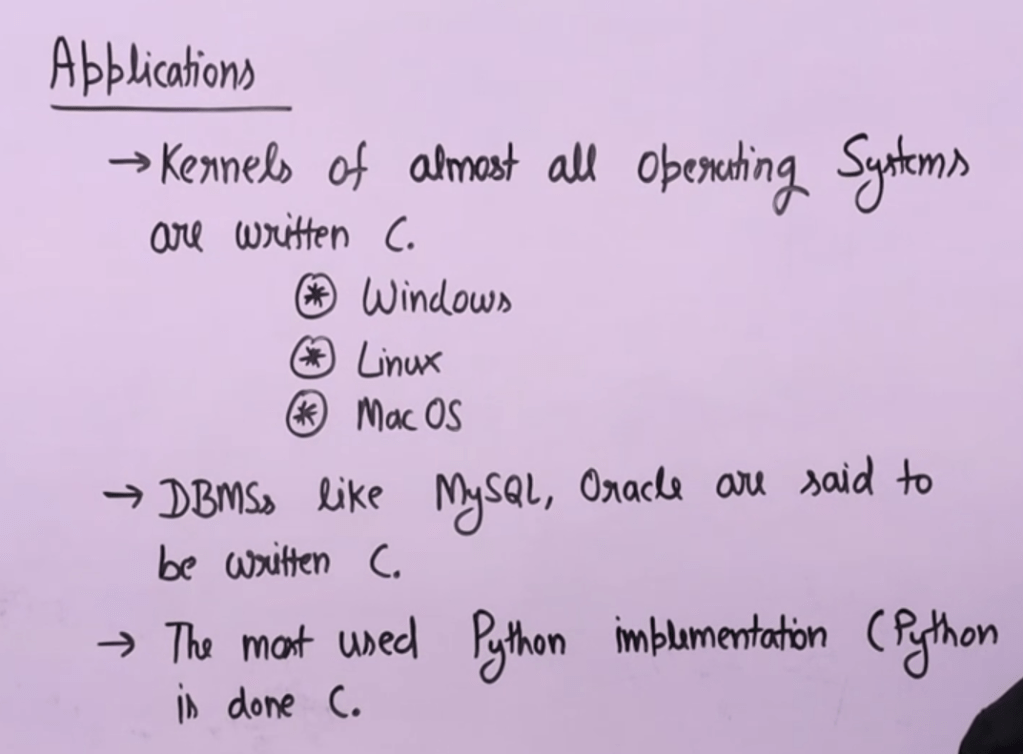
- Operating Systems: C was originally developed to write the UNIX operating system, and it is still widely used today to develop operating systems for computers and embedded devices. Examples of operating systems written in C include Linux, Windows, macOS, and many others.
- System-level software: C is well-suited for developing system-level software that interacts with hardware directly, such as device drivers, network protocols, and file systems. Examples of system-level software written in C include the Apache web server, the MySQL database management system, and the OpenSSL encryption library.
- Embedded systems: C is widely used to develop software for embedded systems, such as microcontrollers, sensors, and other small devices. Examples of embedded systems written in C include the firmware that runs on your car’s engine control unit, the software that controls your home thermostat, and the code that powers your smartwatch.
- Games: C is a popular choice for developing video games, particularly on consoles and mobile devices. Examples of games written in C include Doom, Quake, and many others.
- Scientific and engineering applications: C is used extensively in scientific and engineering applications, particularly in fields such as signal processing, image analysis, and simulation. Examples of scientific and engineering applications written in C include the MATLAB programming language, the OpenCV computer vision library, and the NAMD molecular dynamics simulation package.
Overall, C is a versatile language that can be used to develop a wide range of applications, from operating systems and system-level software to games and scientific applications.
C is a procedural programming language.
It was initially developed by Dennis Ritchie in the year 1972. It was mainly developed as a system programming language to write an operating system.
The main features of the C language include low-level memory access, a simple set of keywords, and a clean style, these features make C language suitable for system programming like an operating system or compiler development.
Many later languages have borrowed syntax/features directly or indirectly from the C language. Like syntax of Java, PHP, JavaScript, and many other languages are mainly based on the C language. C++ is nearly a superset of C language (Few programs may compile in C, but not in C++).
The main features of C language are –
- Low level access to memory
- Simple set of keywords and clean style
- Suitable for system programming like Operating System or Compiler Development
Benefits of C Language
- As a middle-level language, C combines the features of both high-level and low-level languages. It can be used for low-level programming, such as scripting for drivers and kernels and it also supports functions of high-level programming languages, such as scripting for software applications etc.
- C is a structured programming language which allows a complex program to be broken into simpler programs called functions. It also allows free movement of data across these functions.
- Various features of C including direct access to machine level hardware APIs, the presence of C compilers, deterministic resource use and dynamic memory allocation make C language an optimum choice for scripting applications and drivers of embedded systems.
- C language is case-sensitive which means lowercase and uppercase letters are treated differently.
- C is a general-purpose programming language and can efficiently work on enterprise applications, games, graphics, and applications requiring calculations, etc.
- C language has a rich library which provides a number of built-in functions. It also offers dynamic memory allocation.
- C implements algorithms and data structures swiftly, facilitating faster computations in programs. This has enabled the use of C in applications requiring higher degrees of calculations like MATLAB and Mathematica.
Riding on these advantages, C became dominant and spread quickly beyond Bell Labs replacing many well-known languages of that time, such as ALGOL, B, PL/I, FORTRAN, etc. C language has become available on a very wide range of platforms, from embedded microcontrollers to supercomputers.
The C language has formed the basis for many languages including C++, C–, C#, Objective-C, BitC, C-shell, csh, D, Java, JavaScript, Go, Rust, Julia, Limbo, LPC, PHP, Python, Perl, Seed7, Vala, Verilog and many more other languages are there.

