The range of values supported by each data type.
#include <limits>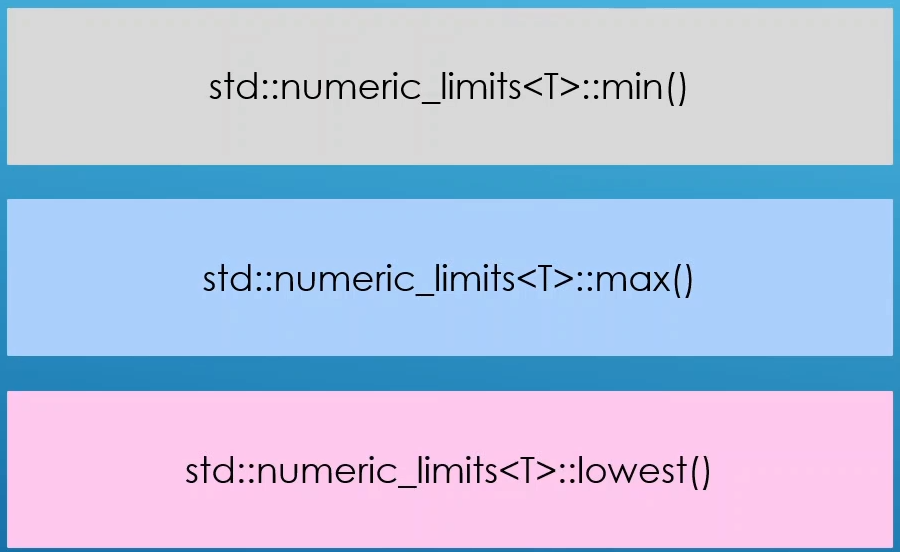
Floating types
- min – smallest positive number that we can represent for that type.
- max – maximum number that you can represent.
- lowest – lowest negative number that you can represent
Integral types
- min – minimum value that we can represent for integral type
- max – maximum value that we can represent
- lowest – doesn’t make sense for integral types.
Code example
#include <iostream>
#include <limits>

int main(){

	std::cout << "The range for short is from " << std::numeric_limits<short>::min() << " to "
        << std::numeric_limits<short>::max() << std::endl;

    std::cout << "The range for unsigned short is from " << std::numeric_limits<unsigned short>::min() << " to "
        << std::numeric_limits<unsigned short>::max() << std::endl;


	std::cout << "The range for int is from " << std::numeric_limits<int>::min() << " to "
        << std::numeric_limits<int>::max() << std::endl;

    std::cout << "The range for unsigned int is from " << std::numeric_limits<unsigned int>::min() << " to "
        << std::numeric_limits<unsigned int>::max() << std::endl;

    std::cout << "The range for long is from " << std::numeric_limits<long>::min() << " to "
        << std::numeric_limits<long>::max() << std::endl;

    std::cout << "The range for float is from " << std::numeric_limits<float>::min() << " to "
        << std::numeric_limits<float>::max() << std::endl;

    std::cout << "The range(with lowest) for float is from " << std::numeric_limits<float>::lowest() << " to "
        << std::numeric_limits<float>::max() << std::endl;

    std::cout << "The range(with lowest) for double is from " << std::numeric_limits<double>::lowest() << " to "
        << std::numeric_limits<double>::max() << std::endl;

    std::cout << "The range(with lowest) for long double is from " << std::numeric_limits<long double>::lowest() << " to "
        << std::numeric_limits<long double>::max() << std::endl;


    //Other facilities
    //More info : https://en.cppreference.com/w/cpp/types/numeric_limits
    std::cout << "int is signed : " << std::numeric_limits<int>::is_signed << std::endl;
    std::cout << "int digits : " << std::numeric_limits<int>::digits << std::endl;
    return 0;
}
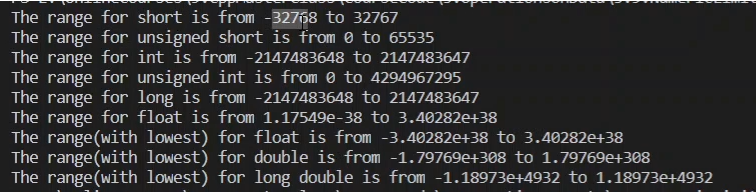
Output :
other utility functions in limits header file :


