Byte data type
In Scala, the Byte data type is an 8-bit signed integer, which means it can hold integer values from -128 to 127. It is one of the primitive types under the AnyVal category, representing value types in Scala.
Key Points about Byte:
- Size: 8 bits (1 byte)
- Range: -128 to 127
- Usage: Used when you need to represent small integers in a memory-efficient way.
- Default value:
0(if uninitialized in classes)
val variableName: Byte = value
Example declarations :
val b1: Byte = 100         // Valid, within the range
val b2: Byte = -50         // Valid, within the range

// val b3: Byte = 200      // Error, as 200 is out of range for Byte
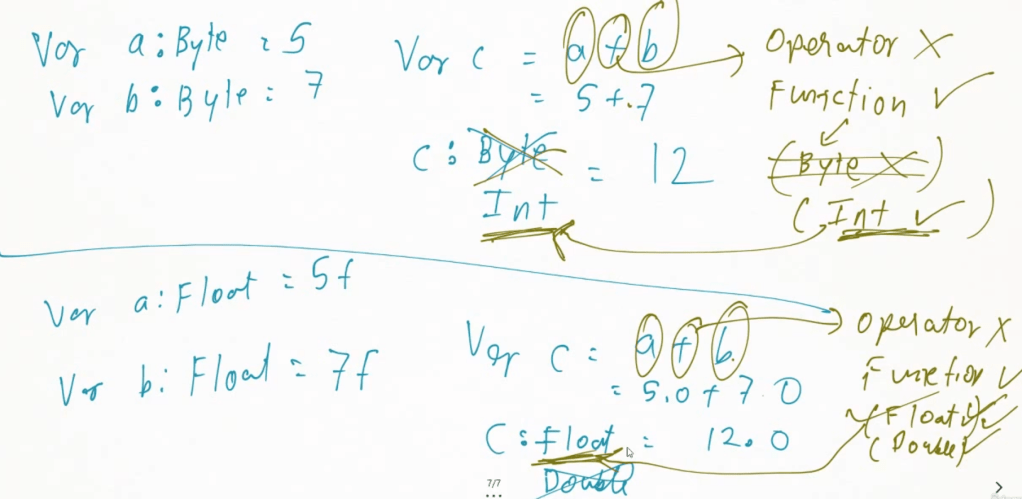
You can perform basic arithmetic operations on Byte values, but keep in mind that the result might need to be cast back to Byte, as operations may result in an Int.
val b1: Byte = 50
val b2: Byte = 30

// Addition
val sum: Byte = (b1 + b2).toByte   // The result is an Int, so we cast back to Byte
println(s"Sum: $sum")              // Output: Sum: 80

// Subtraction
val difference: Byte = (b1 - b2).toByte
println(s"Difference: $difference") // Output: Difference: 20

// Multiplication
val product: Byte = (b1 * b2).toByte
println(s"Product: $product")       // Output: Product: 44 (Byte wraps around if out of range)
Byte Overflow:
Since the range of Byte is limited from -128 to 127, exceeding this range causes overflow, which wraps the value around.
val b1: Byte = 127
val b2: Byte = (b1 + 1).toByte  // Overflow happens here
println(s"Overflow: $b2")        // Output: Overflow: -128

val b3: Byte = -128
val b4: Byte = (b3 - 1).toByte  // Underflow happens here
println(s"Underflow: $b4")       // Output: Underflow: 127
Comparisons:
You can also compare Byte values using relational operators such as ==, <, >, etc.
val b1: Byte = 10
val b2: Byte = 20

println(b1 == b2)  // Output: false
println(b1 < b2)   // Output: true
println(b1 > b2)   // Output: false
Casting:
You can cast other numeric types (such as Int, Long, Double) to Byte using .toByte, but note that the value might get truncated or lose precision if it’s out of the Byte range.
val i: Int = 130
val b: Byte = i.toByte    // Truncates the value, since 130 is out of Byte's range
println(b)                // Output: -126 (130 - 256)

val d: Double = 20.99
val b2: Byte = d.toByte   // Converts the double to a byte, losing the decimal part
println(b2)               // Output: 20
Default Initialization:
In case a Byte is declared but not initialized, its default value is 0.
class Example {
  var b: Byte = _    // `b` is initialized to default value 0
  println(b)         // Output: 0
}
toByte function
In Scala, the toByte function is used to convert a given value from another numeric type (like Int, Long, Double, etc.) into a Byte. Since the Byte data type only holds values between -128 and 127, if the value being converted is outside of this range, it will be wrapped around (overflow) to fit into the Byte range.
value.toByte
Supported Conversions:
You can use .toByte to convert values from the following numeric types:
IntLongShortDoubleFloatChar
val intVal: Int = 100
val byteVal: Byte = intVal.toByte
println(byteVal)  // Output: 100
Converting Floating-point Numbers to Byte
When converting Float or Double to Byte, the decimal part is truncated, and the integer part is converted.
val doubleVal: Double = 123.456
val byteVal: Byte = doubleVal.toByte
println(byteVal)  // Output: 123

val floatVal: Float = -200.99f
val byteVal2: Byte = floatVal.toByte
println(byteVal2)  // Output: 56 (as -200.99 wraps around)
Conversion from Char to Byte
You can convert a character to its corresponding Byte value (i.e., the ASCII/Unicode value of the character).
val charVal: Char = 'A'
val byteVal: Byte = charVal.toByte
println(byteVal)  // Output: 65 (ASCII value of 'A')
The .toByte function is useful for converting numeric values to the Byte data type, though special care must be taken to handle overflow and precision loss during conversion.
Summary:
Byteis an 8-bit signed integer with a range of -128 to 127.- Arithmetic operations on
Bytemay need to be cast back toByte. Byteis useful when working with small, memory-efficient integers.- Overflow and underflow cause the values to wrap around.
val byte1: Byte = 100
val byte2: Byte = -50
println(s"Byte1: $byte1, Byte2: $byte2")  // Output: Byte1: 100, Byte2: -50

val sum: Byte = (byte1 + byte2).toByte
println(s"Sum: $sum")  // Output: Sum: 50
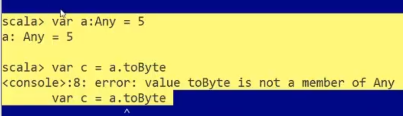
toByte function method can only be used with numeric data types. This method can’t be used with Any type.
Nothing data type
In Scala, Nothing is a special data type that represents the bottom type in Scala’s type hierarchy. It is the subtype of every other type, meaning that a value of type Nothing can be used in any type context. However, there are no values of type Nothing, and it is typically used to signal non-returning expressions, such as exceptions or program terminations.
Key Characteristics of Nothing:
- No instances: There are no actual values of type
Nothing. - Bottom type: It is the subtype of all other types. This means you can use
Nothingwhere any other type is expected. - Non-returning methods: It is mainly used for methods that never return (i.e., methods that throw an exception or exit the program).
Use Cases for Nothing:
- Exception Handling: When a method throws an exception, the method is considered to return
Nothingbecause it never completes normally. - Non-returning Functions: If a function deliberately never returns (e.g., an infinite loop or program exit), its return type is
Nothing. - Covariance in Generics:
Nothingis useful in defining generic types because it can be assigned to any type. This is particularly important when dealing with collections and inheritance in a type-safe manner.
Example 1: Methods that Throw Exceptions
In this case, Nothing is used as the return type of a method that throws an exception, indicating that the method never returns normally.
def error(message: String): Nothing = {
  throw new RuntimeException(message)
}

// Usage example
val x: Int = error("Something went wrong!")  // `x` is inferred as Int, though `error` returns Nothing
The method error has a return type of Nothing because it always throws an exception and never returns a normal value. Despite the return type being Nothing, you can assign the result of error to a variable of any type (in this case, Int).
Example 2: Infinite Loop or Program Termination
You can also use Nothing in functions that cause the program to exit, such as infinite loops or system termination.
def infiniteLoop(): Nothing = {
  while (true) {
    println("This will run forever")
  }
}
In this case, the method infiniteLoop has a return type of Nothing because it never returns (it loops infinitely).
Example 3: Covariance with Generic Types
In Scala, Nothing is often used with generic types to represent an empty or bottom case.
Example with Option:
Option[Nothing] can represent an empty value because Nothing can be assigned to any type.
val noneValue: Option[Nothing] = None
val someValue: Option[Int] = Some(42)

def handleOption(opt: Option[Int]): Unit = opt match {
  case Some(value) => println(s"Value: $value")
  case None => println("No value")
}

handleOption(noneValue)   // Output: No value
handleOption(someValue)   // Output: Value: 42
Option[Nothing]is used here to representNone, which signifies the absence of a value.Nothingserves as a type that can fit in anyOptiontype.
Example 4: Using Nothing in a List
Since Nothing is a subtype of all types, an empty list in Scala can be represented as List[Nothing]. This is useful because an empty list can be considered as a valid list of any type.
val emptyList: List[Nothing] = List()

def printList[T](list: List[T]): Unit = {
  if (list.isEmpty) println("Empty list")
  else list.foreach(println)
}

printList(emptyList)  // Output: Empty list
List[Nothing] represents an empty list, but because Nothing is a subtype of every type, emptyList can be treated as a list of any type, allowing you to use it generically.
Explanation of the above code :
val emptyList: List[Nothing] = List()
List[Nothing]: This declares a list with the typeNothing. In Scala,Nothingis the bottom type, meaning it is a subtype of all other types. It is commonly used to represent an empty value becauseList[Nothing]can be assigned to any list type (List[Int],List[String], etc.).List(): This creates an empty list. Since it’s empty, it can be typed asList[Nothing], which means it’s an empty list that can be treated generically.
def printList[T](list: List[T]): Unit = {
  if (list.isEmpty) println("Empty list")
  else list.foreach(println)
}
[T]: This defines a generic type parameterTfor the functionprintList. The function can take a list of any type, andTwill be replaced with that specific type when the function is called.list: List[T]: This means the function accepts a list of typeT, whereTcan be any type likeInt,String, etc.Unit: This indicates the function does not return a value (similar tovoidin other languages).- Inside the function:
if (list.isEmpty): It checks if the list is empty.println("Empty list"): If the list is empty, it prints"Empty list".list.foreach(println): If the list is not empty, it usesforeachto iterate through all elements in the list and prints each element usingprintln.
The function printList is generic because it uses [T]. This allows it to handle lists of any type without needing to be redefined for each specific type.
Summary of Nothing:
- Type Hierarchy:
Nothingis at the bottom of the Scala type hierarchy. It is the subtype of every type. - No Instances: No actual values of type
Nothingexist. - Use Cases:
- Used in methods that never return (e.g., those that throw exceptions).
- Can be used for non-returning methods like infinite loops or terminations.
- Useful in defining generic types (e.g.,
Option[Nothing]representsNone).
- Covariance: It’s useful in situations where you need an empty or bottom type that can be used generically.
Conclusion:
The Nothing type in Scala is a powerful tool for dealing with non-returning functions and ensuring type safety in cases where a function does not return normally. It plays a key role in Scala’s type hierarchy, especially in handling generics and edge cases like exceptions and empty collections.
asInstanceOf method
In Scala, asInstanceOf is a method that performs type casting at runtime. It is used to cast an object from one type to another. This method is defined in the Any class, so this method can be used on any variable.
obj.asInstanceOf[TargetType]
You can use asInstanceOf to cast between numeric types such as Int, Double, Float, etc.
val x: Double = 100.0
val y: Int = x.asInstanceOf[Int]
println(y)  // Output: 100
In this example, x is a Double, but we cast it to Int using asInstanceOf[Int]. This truncates the decimal part.
asInstanceOf is used for runtime type casting in Scala.
Unit data type
In Scala, Unit is a special data type used to represent the absence of a meaningful value. It is similar to void in languages like Java or C, but unlike void, Unit is a proper type with a single value: () (an empty tuple).
Key Characteristics of Unit:
- Return Type: Used for methods or expressions that do not return a value (side-effecting functions like
println). - Single Value: The only value it holds is
()(empty tuple). - Type of Side-Effects: Functions that perform actions (side effects) without producing a value (like writing to a file or printing to the console) typically return
Unit.
def method(): Unit = {
  // Some code that produces a side effect
}
Example 1: Method with Unit Return Type
A typical case for using Unit is in functions or methods that perform actions, such as printing something or modifying external state, but do not return a value.
def greet(): Unit = {
  println("Hello, world!")
}

greet()  // Output: Hello, world!
- Here, the
greetfunction does not return anything useful. Instead, it performs a side effect (printing to the console). - The return type is
Unit, and Scala implicitly returns()after executing the function.
Example 2: Unit in Assignments
A block of code that doesn’t return a meaningful result, but rather performs an action, has the type Unit.
val result: Unit = {
  println("This is a side effect")
}

println(result)  // Output: ()
- The block of code assigned to
resultis of typeUnit, so the value stored inresultis().
Example 3: Ignoring Return Values
You can use Unit to ignore the return value of a function if you’re only interested in the side effect.
def add(x: Int, y: Int): Int = {
  x + y
}

val ignoredResult: Unit = add(5, 10)
println(ignoredResult)  // Output: ()
- Even though the
addfunction returns anInt, here it’s assigned to aUnit, so the result of the addition is ignored, and()is returned.
Example 4: Side-Effecting Methods
Many side-effecting methods, such as logging, writing to a database, or performing I/O operations, typically return Unit because the goal of these methods is to modify some state, not to return a value.
def logMessage(msg: String): Unit = {
  println(s"LOG: $msg")
}

logMessage("This is a log entry.")
Example 5: Unit in Conditionals
If you use a conditional expression that does not produce a meaningful result, the type of the expression will be Unit.
val condition: Boolean = true
val result: Unit = if (condition) println("Condition is true") else println("Condition is false")

println(result)  // Output: ()
- In this case, both branches of the
ifstatement produce a side effect (printing to the console) and returnUnit.
Example 6: Unit in Loops
A while or for loop typically returns Unit, as loops are often used for their side effects rather than returning values.
var i = 0
while (i < 3) {
  println(i)
  i += 1
}
// Output:
// 0
// 1
// 2
- The
whileloop performs a side effect (printing numbers) and returnsUnit.
Example 7: Unit as a Method Placeholder
In functional programming, it’s common to use Unit as a placeholder when designing higher-order functions that don’t always require a meaningful return value.
def doTwice(f: () => Unit): Unit = {
  f()
  f()
}

doTwice(() => println("Side effect"))
// Output:
// Side effect
// Side effect
- The
doTwicefunction accepts another functionfthat returnsUnit. It callsftwice, but the result is not important.
Key Use Cases:
- Side-effecting methods: Functions that perform actions like printing, logging, or modifying external state but don’t return a value.
- Ignored return values: When you want to call a function but don’t care about its return value.
- Control flow structures: Conditionals and loops that perform actions rather than return values.
Summary:
Unitin Scala represents a method or expression that performs an action but does not return a meaningful result.- Functions with
Unitreturn type are often side-effecting, such as logging or printing. Unithas a single value,(), which signifies the absence of a meaningful return value.

