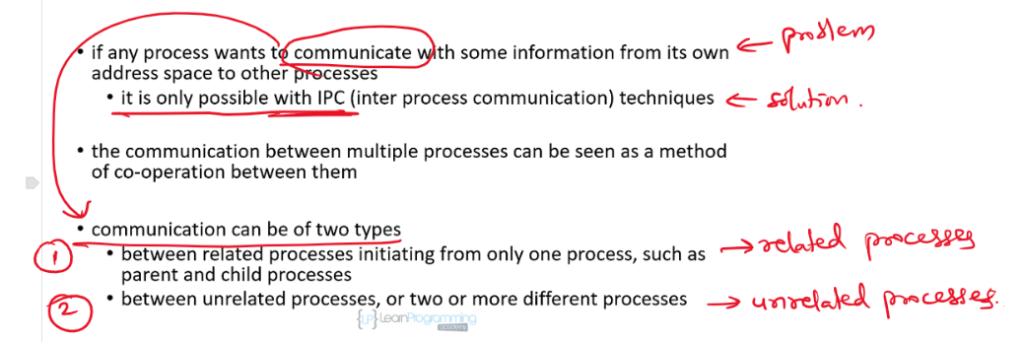
In computing, Inter-Process Communication (IPC) refers to the mechanisms that allow different processes to communicate with each other and share resources.
IPC is required for various reasons
- Coordination – IPC enables processes to communicate and coordinate with each other, which is essential in many computing tasks. For example, a producer-consumer pattern is implemented using IPC mechanisms, where one process produces data, and another process consumes it.
- Performance: IPC mechanisms can also be used to improve system performance by minimizing the overhead associated with process communication. For example, shared memory is a high-performance IPC mechanism that allows multiple processes to share a region of memory.
- Sharing resources: IPC is used to enable multiple processes to access and share the same resources, such as memory, files, and devices. This is important in multi-user systems and when multiple processes need to work together to achieve a common goal.
- Distributed systems: IPC is critical in distributed systems, where processes may be running on different machines connected over a network. In such systems, IPC is used to facilitate communication between processes running on different machines.
Contexts where IPC is needed ?
IPC is used in a variety of contexts, including operating systems, distributed systems, and parallel computing.
In operating systems, IPC mechanisms are used to enable different processes to communicate with each other and share resources such as memory, files, and hardware devices.
For example, when a user runs a program on a computer, the operating system creates a process for the program and provides it with the resources it needs to run, such as memory and CPU time. If the program needs to communicate with another program or process, it can use an IPC mechanism such as sockets, pipes, or shared memory to exchange data.
In distributed systems, IPC mechanisms are used to enable different nodes or machines to communicate with each other and share resources. Distributed systems are composed of multiple computers that are connected by a network and work together to achieve a common goal.
IPC mechanisms such as message queues and sockets are used to send messages and data between different nodes in a distributed system.
In parallel computing, IPC mechanisms are used to enable different threads or processes to communicate with each other and coordinate their activities. Parallel computing refers to the use of multiple processors or cores to perform computations in parallel, which can improve performance and efficiency.
IPC mechanisms such as semaphores and message passing are used to synchronize the activities of different threads or processes and ensure that they access shared resources correctly.
Overall, IPC is a fundamental concept in computing, enabling different processes, nodes, or threads to work together and achieve common goals.
The choice of IPC mechanism depends on the specific requirements of the application, including performance, reliability, and scalability.
Need for IPC
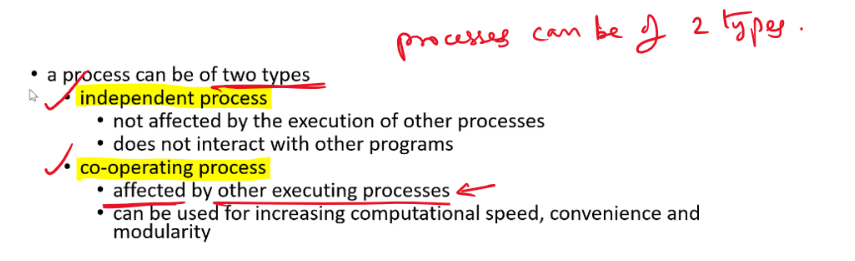
Processes can be of 2 types :
- independent process
- co-operating process
What if you want to send specific data from one process to another process or read output of some other process ?
IPC lets processes work together.

Types of communication to consider during IPC :
- communication between related processes
- communication between un-related processes