What is Collections Framework
The Collections Framework in Java is a unified architecture that provides a set of interfaces, classes, and algorithms to manipulate and store collections of objects. It was introduced in Java 1.2 and is part of the java.util package.
The Collections Framework offers a wide range of data structures, such as lists, sets, queues, and maps, along with various utility classes for working with collections. These structures and utilities are designed to be efficient, flexible, and reusable.
These are ready to use, highly efficient data structures which we can use right out of the box without having to implement ourselves.
Key components of the Collections Framework
Here are some key components of the Collections Framework:
- Interfaces: The framework defines several core interfaces, including List, Set, Queue, Map, and their sub-interfaces. These interfaces provide common methods and contracts for working with collections.
- Implementations: The framework provides various classes that implement the collection interfaces. For example, ArrayList and LinkedList are implementations of the List interface, HashSet and TreeSet implement the Set interface, and HashMap and TreeMap implement the Map interface. These implementations offer different performance characteristics and behaviors to suit different needs.
- Algorithms: The Collections class provides a set of algorithms, such as sorting, searching, shuffling, and reversing, which can be applied to collections. These algorithms are implemented as static methods and can be used with any collection that satisfies the requirements.
- Utility classes: The Collections Framework includes utility classes like Collections and Arrays that provide additional functionality for manipulating and working with collections. These classes offer methods for operations like collection conversion, synchronization, and filling collections with default values.
The Collections Framework simplifies the process of working with collections by providing a consistent and standardized way to handle them. It promotes code reusability and improves code quality by encouraging the use of interfaces and providing efficient implementations for common collection types.
General Requirements
General requirements which need to be fulfilled by data structures for real world use cases :
- No knowledge about size
- Automatically extendable
- Fast random access
- Fast lookups
- Ordered vs Unordered
- null vs non-null data
- Duplicate vs Unique
- Automatic sorting
- <key, value> mapping
Collections Framework includes different kinds of data structures that would meet one or more of these requirements.
Core Interfaces in Collections Framework
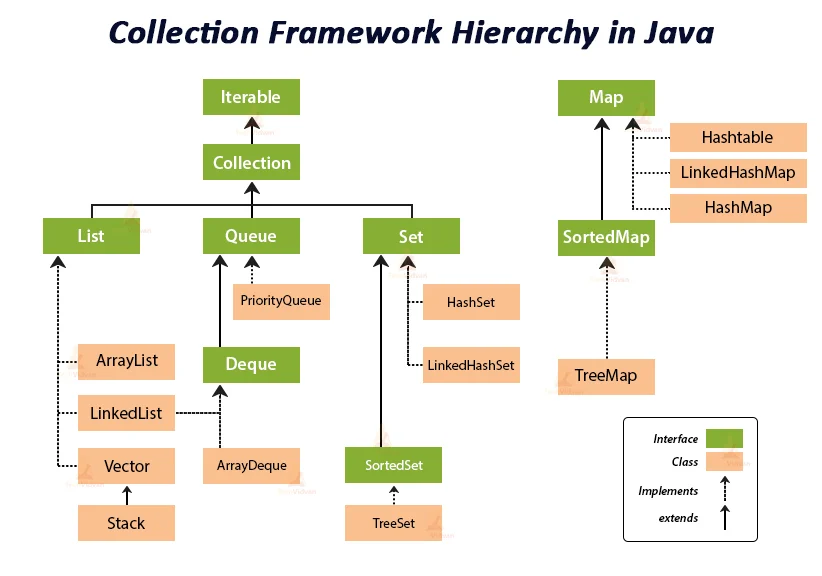
source – https://techvidvan.com/tutorials/java-collection-framework/
- Collection – would represent a collection of objects.
- Map – would represent <key, value> pairs.
Most of the implementation permit storing null values; the implementations are not synchronized.
SortedSet, SortedMap – as the name implies they ensure that the data they store is automatically sorted, meaning elements are placed at appropriate positions.
NOTE – Set implementations internally use Map implementations.
Legacy Implementations
In the Java Collections Framework, there are certain legacy implementations that have been retained for compatibility reasons but are generally considered less preferred than their modern alternatives.
The legacy implementations are considered less efficient due to factors such as synchronization overhead, lack of type safety, and limited functionality. The modern alternatives provide improved performance, type safety, and additional features.
Legacy implementations – these are synchronized data structures. Recommended, not to use these classes any more.
- Vector – replace with ArrayList, LinkedList
- HashTable – replace with HashMap, LinkedHashMap
- Stack – replace with ArrayDeque
Set implementation uses Map
In Java, the implementation of the Set interface in the Collections Framework often internally uses a Map implementation to store its elements.
The Set interface is designed to store a collection of unique elements, where duplicates are not allowed. To ensure uniqueness, Set implementations rely on the keys of a Map to store the elements. The elements themselves are stored as keys, leveraging the fact that a Map cannot contain duplicate keys.
When adding elements to a Set, the implementation typically adds the elements as keys into an underlying Map implementation and uses a dummy value (e.g., Boolean.TRUE) as the associated value.
- The map’s key set represents the elements of the
Set, and the uniqueness property is automatically enforced by the map’s behavior.
By utilizing a Map internally, Set implementations can take advantage of the efficient key-based operations provided by the map, such as constant-time contains, add, and remove operations, which are crucial for maintaining the integrity of a Set.
It’s important to note that the specific implementation details may vary across different Set implementations in Java, such as HashSet, TreeSet, or LinkedHashSet. However, the underlying usage of a Map data structure to enforce uniqueness remains a common approach.
Java Collection Framework classes – Serializable
Most of the implementations in Collection Framework are serializable.
In Java, when a class implements the Serializable interface, it means that objects of that class can be converted into a stream of bytes and then saved to a file or transferred over a network. The process of converting an object into a stream of bytes is known as serialization.
The Serializable interface acts as a marker interface, meaning it does not define any methods that need to be implemented. Its purpose is to indicate that an object of the implementing class can be serialized.
For the Java Collections Framework, many of the classes and interfaces, including List, Set, Map, and their implementations like ArrayList, HashSet, HashMap, etc., are designed to be serializable. This allows you to serialize instances of these classes and store them persistently or transmit them across a network.
When a collection class is serializable, it means you can write the collection object to an ObjectOutputStream and read it back from an ObjectInputStream, preserving its state and contents.
Here’s an example of serializing a List implementation (ArrayList) to a file:
import java.io.*;
import java.util.ArrayList;
import java.util.List;

public class SerializationExample {
    public static void main(String[] args) {
        List<String> myList = new ArrayList<>();
        myList.add("Hello");
        myList.add("World");

        // Serialize the list to a file
        try (ObjectOutputStream outputStream = new ObjectOutputStream(new FileOutputStream("list.ser"))) {
            outputStream.writeObject(myList);
        } catch (IOException e) {
            e.printStackTrace();
        }

        // Deserialize the list from the file
        try (ObjectInputStream inputStream = new ObjectInputStream(new FileInputStream("list.ser"))) {
            List<String> deserializedList = (List<String>) inputStream.readObject();
            System.out.println(deserializedList);
        } catch (IOException | ClassNotFoundException e) {
            e.printStackTrace();
        }
    }
}
In this example, the ArrayList object myList is serialized to a file named list.ser. Later, the list is deserialized and printed, restoring its original state.
** It’s worth noting that not all classes in the Java Collections Framework are serializable. For example, concurrent collections like ConcurrentHashMap and specialized collections like PriorityQueue may not implement the Serializable interface due to their complex internal state or synchronization requirements.
When using serialization, it’s important to be aware of the potential issues related to versioning, security, and compatibility between different Java versions or platforms. It’s recommended to carefully design and test the serialization and deserialization process to ensure data integrity and compatibility.
Java Collection Framework classes – Clone
In the Java Collections Framework, some classes provide a clone() method to create a shallow copy of the object. The clone() method creates a new instance of the same class and copies the values of the internal data structures and fields into the new instance. However, it’s important to note that the clone() method is considered to be somewhat problematic and is not widely used in modern Java programming.
- By default, the
clone()method creates a shallow copy of the object. This means that the internal data structures are not cloned deeply, and both the original and cloned objects share references to the same objects. Changes made to the shared objects may affect both the original and cloned instances. - Required Casting: The
clone()method returns a copy of the object as anObjecttype. To use the cloned object as the specific type, you need to cast it appropriately. For example:
ArrayList<String> originalList = new ArrayList<>();
originalList.add("Hello");
originalList.add("World");

ArrayList<String> clonedList = (ArrayList<String>) originalList.clone();
Alternatives: In modern Java programming, it is often recommended to use alternative approaches for creating copies of objects, such as copy constructors, factory methods, or the copyOf() methods provided by some collection classes (List.copyOf(), Set.copyOf(), etc.). These approaches provide more control and clarity over the copying process.
To summarize, while the clone() method exists in some classes of the Java Collections Framework, it is generally not recommended to use clone() method due to its limitations and potential issues. It is advisable to consider alternative approaches for creating copies of objects that better suit the requirements of your specific use case.

